
Transgrancanaria - How to Run a Great Race
This is quite possibly my favourite race! I have raced in 2020 (30K starter distance), 2022 (62K advanced distance) 2023 (85K advanced) and 2024 (Marathon). Apart from a 7 th place finish in the marathon (of which I was delighted as the field was stacked and super fast!) the rest have been top 5 including a win in the 2020 race. I have ran that Barranco at the end an unbelievable amount of times! Some years it has been hot for the duration. There have been two years where the weather has been a crazy contrast in the mountains (very cold, windy, raining) compared with the section from Tunte to the finish (boiling hot!). Here are some of my top tips to help you to run a great race.
The end section in the Barranco (Ayagueres to the finish line)
Think high cadence and look for the more trodden lines in the river bed. It can get HOT in there so make sure you have left Ayagueres with enough hydration and nutrition.
Race strategy wise, I have always wanted to be running that last uphill as much as possible as it is a runnable gradient for most people. Throughout the race I am thinking about looking after myself really well and the other processes in my control that will make this possible. I am taking extra time to cool off with ice at aid stations, top up bottles etc so I do not get dehydrated and I can be running that final climb the best I can. Depending on the time of day, this climb might be fully exposed in the sun, or there might be some shade closer to the inside of the track. If there is shade, try run in it.
After the climb there is quite a rocky, technical downhill for around 1 KM. After this you very much need running legs for the 9K to the finish. It is not the kind of downhill gradient that gravity will do a lot of the work. You need to still be able to run and with good form over the river bed. The river bed is really rocky in places but you do get some breaks from it where it smooths out. The final 2-3K is overall pretty runnable and smooth. There has been a basic water station with about 2.5K to go on some of the years I have raced but 100% do not bank on this!
Be prepared through training for the net downhill
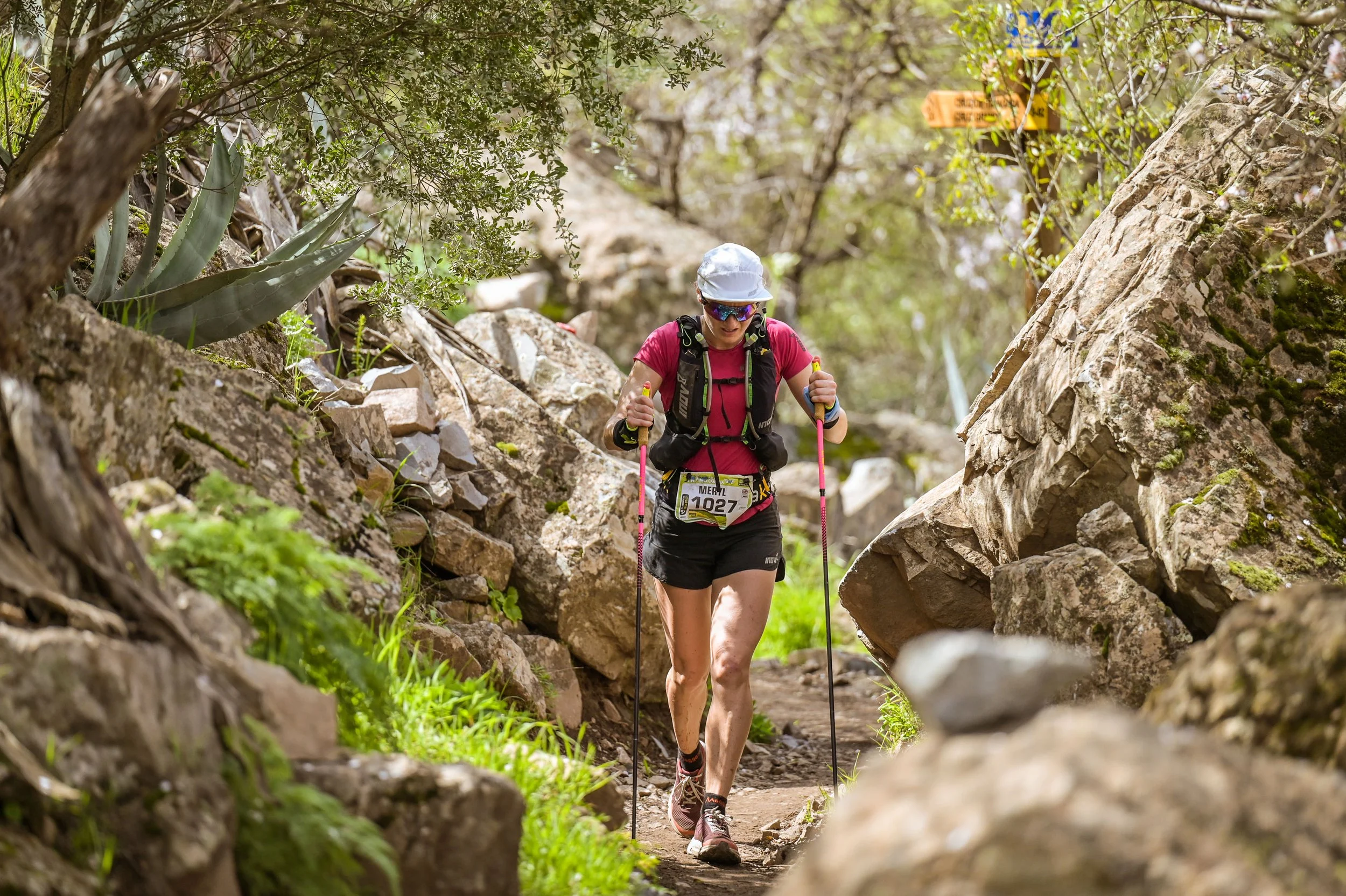
This race has some long, sustained downhills which are also quite technical in nature. The advanced and marathon races usually have more total descending than ascending due to its net downhill. For example the marathon 46K in 2026 has 1784m ascent and 2800m descent.
In training, can you get dropped off at a higher start point for some of your runs so you get more descent than ascent in your session? Make sure you are getting plenty of elevation gain and descent in training also with long downhills practised regularly. This can be a challenge for a lot of people in the winter, especially people in the UK or parts of the world with a lot of snow on their hills/mountains in January/February. You just have to do the best you can and also consider your safety in the hills during the winter. I know this might not be possible for everyone, but, if you really want to do well in this race then I highly recommend a training camp on two in your run up so you can get conditioned appropriately for the demands of this race. If none of this is possible then you will have to make sure you are doing a lot of strength work in the gym including plenty of eccentric loading exercises.
Be prepared for all weathers
There most likely will be a major temperature increase as you go through your race and drop down towards the south of the island. The heat can creep up on runners very quickly and if they have not been hydrating appropriately throughout and cooling before they get hot, their performance will majorly suffer. There are so many benefits of cooling strategies in a race like this. The main ones I have experienced is the lowering of RPE and keeping my stomach happy! For the mountain sections that you need a jacket and more, try to have really convenient ways of removing the items when it gets warmer e.g. wear your jacket over your pack rather than underneath it, pocket space in your pack to put gloves/hat into. I am a huge fan of arm sleeves for this race too.
Pacing through the sections
As discussed earlier, there is a very runnable final section of this race and you want to feel good for this! Therefore I highly recommend you are disciplined in your pacing strategy and do not start too fast. Also, watch that you do not run some of the early long downhills too fast. Again, this is where the temperature increase might creep up on you and if you have also pushed the downhill harder than you should, you might be a bit cooked for the next section.
When I raced the 85K in 2023 I was really pleased with my pacing strategy and moved from 9th to 5th in the second half. There is a great amount of elevation gain over the first section before El Garanon so make sure you do not go too hard on those climbs and descents so you can run the very runnable remainder of the course. Have a point in the race that you want to still feel “fresh at”. This was El Garanon for me in 2023 and it really paid off! I ran through the Barranco at the end of the race quicker that year than when I did the marathon the year before! Yes, it was a bit cooler as it was later in the day but I still think this pacing strategy paid off.
Roads – crew driving
My final tip is for your supporters. If they are driving the mountain roads of Gran Canaria then they need to be confident drivers. The roads can be very narrow in places, with rockfall debris also at times and if you meet a bus on the road you will definitely be breathing in very hard! If they can, get them to do a recce drive of the route so there are no surprises on race day and they know how long it might take them to drive from A to B. The timings on google maps might not be super accurate.
I hope you have a great time in Gran Canaria and run well!
Did you find this helpful? If you want more support with your ultra-trail races, send me a DM on Instagram or an email at hello@merylcoopercoaching.com
I provide running coaching (online and in person), health coaching (helping you to improve your day-to-day nutrition, sleep and other lifestyle choices to maximise your performance in these races) and one-off mentoring calls.